
VKW 126
High-performance, flexible, polymer-modified adhesive for all tile types
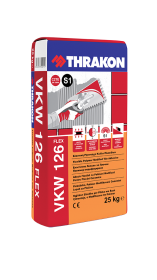
VKW 126 is a high-quality elastic adhesive for absorbent and non-absorbent tiles based on cement and modified with polymer additives for usage on both horizontal and vertical surfaces.
 Enlargement Enlargement
|

VKW 126

Description
VKW 126 is a high-quality elastic adhesive for absorbent and non-absorbent tiles based on cement and modified with polymer additives for usage on both horizontal and vertical surfaces. It consists of cement, quartz sand, lime fillers and improvement additives. VKW 126 presents resistance against slippage, very strong adhesion on all common substrates and high resistance against weather conditions (rain – heat-wave – frost). Moreover, it avails extended open time (up to 30 minutes) thus increasing the productivity of crews. It is classified as an adhesive type C2TE according to ΕΝ 12004 and as S1 according to EN 12002 for interior and exterior applications. VKW 126 FLEX has received an Environmental Product Declaration (EPD) following an assessment of its life-cycle environmental impacts.
Application Fields
- Particularly recommended for the adhesion of both absorbent and non-absorbent tiles (i.e. granites ), on sub-layers requiring high adhesion tolerances, elasticity and resistance to climatic conditions. Its thixotopic qualities allow the crew to commence tile adhesion from the upper side towards the lower one. It is adequate for the adhesion of: small or large ceramic tiles of all type, granites, natural and artificial rock, large slabs, thin marbles, decorative mosaic tiles
- On common substrates such as: concrete, light concrete, porous concrete (YTONG), self-leveling floors, cement screeds, renders, flat walls with filled joints, mosaics.
- On difficult substrates subjected to thermal dilation and heavy traffic as well as in areas with constant moisture such as: heated floors, baths, showers, car showrooms, malls, utility areas, exterior tile layering, porches, roof tops, plaster boards following priming with primer GLX 292 FLEX PRIM and GLX 298 PREMIUM.
Advantages
- Produced with quartz sand
- Resistance against elastic deformation
- Strong adhesion on demanding sub-layers
- Strong adhesion on vertical surfaces
- Adequate for the adhesion of non-absorbent tiles
- Resistance to weather conditions
- Excellent workability
- High tolerance – Fast application
- Resistance to humidity and frost
- CE certified- as per the European standard ΕΝ 12004
Application Steps
The tile laying substrate must be flat, free from brittle and foreign bodies such as plaster residue, paint, oils, etc. It must be stable and free from shrinkage and distortion forces and must not be subject to vibrations. The absorbent sub-layers are primed used GLX 290 primer before application.
Step 2In a clean container add 8.25-8.75 liters of clean water and gradually empty the content of a 25 Kg sack of product FLEX VKW 126, mixing continuously with an electric mixer in order to acquire a uniform slurry mass.
Step 3Let the resulting mixture age for 5 minutes and mix again. The mixture is ready to be used within the next 4 hours.
Step 4Following the preparation of the mixture do not add more water in order to correct the workability of the slurry. This would lead to the reduction of its tolerances and the increase of its shrinkage.
Step 5Spread the adhesive on the surface and then comb the adhesive layer using a special toothed spatula.
Step 6Within 30 min since adhesive layering, place the tiles at their location, pressuring firmly in order to ensure full contact. The installation of tiles on the wall may be performed starting from the upper part with the entire tile and without any slippage.
Step 7The excess adhesive must be cleaned off the joints prior to its drying.
Step 8On surfaces larger than 25m² it is necessary to install expansion joints.
Step 9At the areas of contact of floors with walls it is recommended to use adequate silica-containing pastes.
Step 10During application and for the next 24 hours the environmental and sub-layer temperature must be between +50°C and +35°C.
Step 11The adhesive is cleaned with water while still wet. When it hardens it is removed mechanically.
Storage
Store in sealed bags in a dry environment at temperatures above 0°C for 12 months from the production date.