
FHP 225 WR
Water repellent final coat plaster with marble
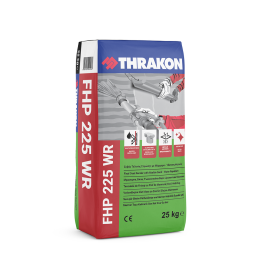
FHP 225 WR is a ready-to-use, water-repellent, white cement-based top coat plaster.
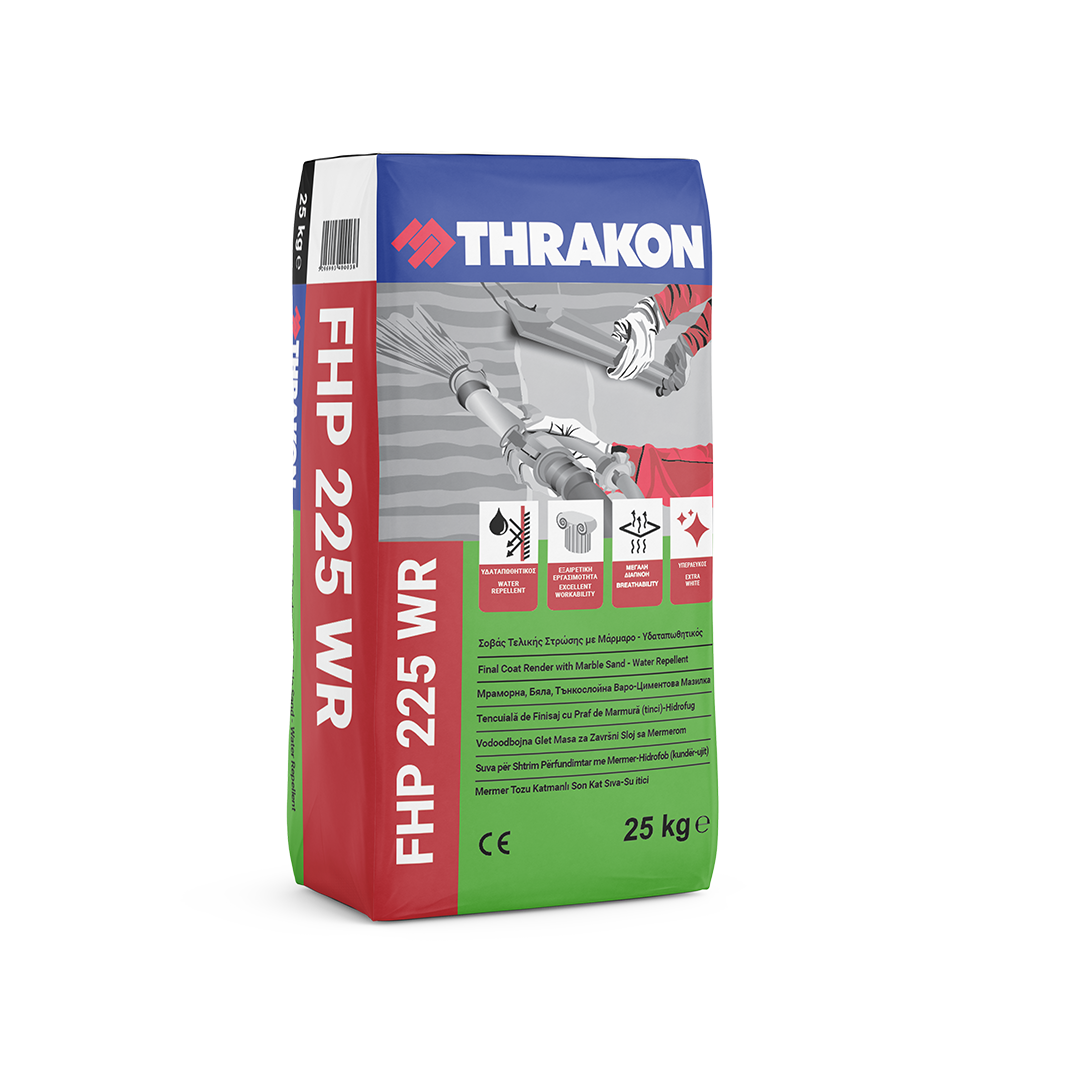 Enlargement Enlargement
|

FHP 225 WR

Description
FHP 225 WR is a ready-to-use, water-repellent, white cement-based top coat plaster. It contains cement, lime hydrate, limestone fillers (marble) and improvement additives. It is produced in two types: FHP 225-0 WR with 0.5 mm max. grain and FHP 225-1 WR with 1.4 mm max. grain. FHP 225 WR has very strong adhesion on previous plaster coats and gives a perfect finish. A surface that has been plastered with FHP 225 WR may breath, won’t retain any rain water and will not develop mildew and grain stains. In addition, they prevent swelling caused from careless extinguishing of lime used in traditional coatings. Produced and inspected as per the European standard EN 998-1.
Application Fields
- FHP 225 WR is used as a final coat plaster in the 3-coat plastering system by THRAKON. It is applied on GHP 210 basic render.
- Appropriate for use indoors and outdoors.
Advantages
- Produced with ultra-white limestone aggregates
- Water-repellent
- Perfect grains distribution
- Allows the surfaces to “breath”
- Strong adhesion on the substrate
- Excellent workability
- Sticks to building surfaces without dropping
- High resistance – fast application
- Perfect finish; smooth surfaces
- Replaces traditional plasters
- CE-certified – according to the European Standard EN 998-1
Application Steps
Application is performed on appropriately prepared surface.
Step 2Immediately and while the plaster is still fresh, smooth the surface using a metal edge.
Step 3As soon as the plaster begins to dry you must rub it with a hard float and apply the final coat on wall edges etc.
Step 4If you wish to get a fine finish (smoother surface) allow the plaster to dry a little more before rubbing with a soft float - sponge.
Step 5You must avoid smoothing the plaster by pressing it while the plaster is still fresh, because plaster condensates and the possibility of flaking-off increases.
Step 6The time needed for plaster to dry may be affected by the prevailing weather conditions and the state of the building structure.
Storage
Store in sealed bags in a dry environment at temperatures above 0°C for 12 months from the production date.