

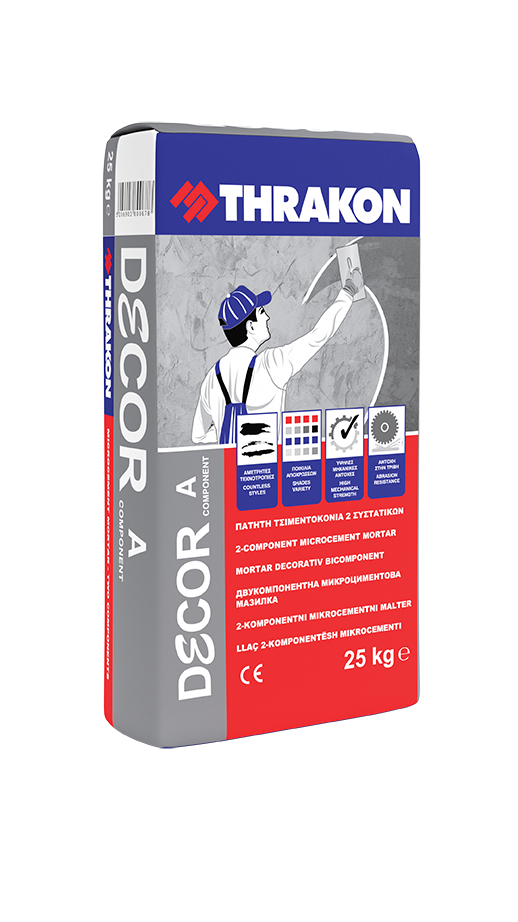
Polished cement screed mortar – 2 components
Polished cement screed mortar – 2 components
 Enlargement Enlargement
|
 Δείτε το Video Δείτε το Video
|
Polished cement screed consisting of two components for creating colored decorative surfaces on floors and walls. Creates the traditional Greek Cycladic style with water formations. Applied at a thickness 2 – 10mm, in a single layer on a solid and properly primed substrate.
Combined with the reinforcing fiberglass mesh CLIMAPLUS.
The substrate should be levelled, free from loose particles, free of grease and oils. Detached plaster parts should be repaired with WRM 550. For application on plaster, concrete, masonry the substrate slightly wetted. Very absorbent substrates should be primed with GLX 292 FLEX PRIM. Non-absorbent substrates such as old paving, marble, mosaics, etc. should be primed with GLX 190.
Step 2In a clean container add the emulsion (5kg), the pigment and stir well. Stir the liquid mixture to homogenize and then empty the content of the 25kg bag under continuous stirring and fill with the necessary quantity of water (1,5- 2 kg) until the formation of a uniform slurry without lumps.
Step 3Let the mixture rest for 3 minutes, stir again and use. Apply the product by combing the substrate with a notched trowel in 1-3mm thickness.
Step 4Once the material starts to dry apply a second layer using a flat trowel and if required by the application apply a third one or more (provided that there hasn’t been preceded varnish application) until you achieve the desired effect or shade.
Step 5Once the material hardens it can be sanded if desired be using suitable sandpaper in order to achieve a very smoother surface finish. 48 hours after the application the product should be covered with a suitable protective varnish from THRAKON range (depending on application) for sealing the surface.
Step 6For application in thickness greater than 3mm, on substrates that will be imposed to high loads, are subject to shocks and vibrations or on cracked substrates it is recommended to apply fiberglass mesh (CLIMAPLUS - 160g/m2) embedded in the first layer of the application of the microcement coating.
Step 7Avoid mixing different batches in the same area (possibility of a different shade) and avoid mixing with sand, gypsum, cement, resins or other binders.
Step 8When the mixture has started to set and it is no workable anymore, it must be rejected.
The mortar (part A) is packed in 25kg bags and the polymer emulsion (part B) in 5kg plastic containers.
They kept stored on wooden pallets in a dry environment at temperatures higher than 0°C for 12 months from the date of production.
Polished cement screed mortar – 2 components
Polished cement screed mortar – 2 components
Polished cement screed mortar – 2 components
Polished cement screed mortar – 2 components
Polished cement screed mortar – 2 components
Polished cement screed mortar – 2 components
Polished cement screed mortar – 2 components